Throughout the U.S., bike lanes are being proposed and installed to help protect bicyclist from cars. More than 700 cyclists were killed in the U.S. in 2012 in traffic related accidents, according to data released from the National Highway Traffic Safety Administration. Bike lanes are helping, but are they enough?
Nick Falbo, a Portland-based urban planner doesn't think so.
“We know that protected bike lanes are the key to getting the average person to consider traveling by bike. Sharing busy traffic lanes with cars is absolutely unacceptable, and separation by a line of paint is often not enough. Protected Bike Lanes, also called cycle tracks, use curbs, planters, or parking to buffer bicyclists from moving cars,” Falbo said. “But there is still a problem; the protected bike lanes lose their benefits when they reach intersections. The buffer falls away, and you're faced with an ambiguous collection of green paint, dashed lines and bicycle symbols.”
During a transportation challenge organized by Georg Mason University's School of Public Policy, Falbo proposed the plan for a protected intersection.
Based on Dutch intersection designs, The Protected Intersection keeps a cyclist physically protected throughout the intersection. It makes left turns simple and safe; and right turns protected and fast, while eliminating possible conflict with cars.
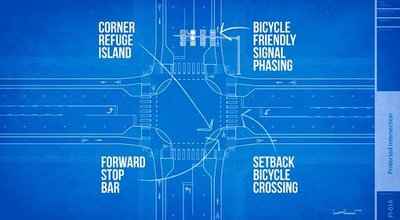
“With this design, riders will never feel stranded, exposed, or unsure of where to go and how to get there,” Falbo said.
There are four main elements to a protected intersection
1. Corner Refuge Island - This is the key element in the intersection. It is an actual island in the intersection that creates a physical, protective barrier that separates cars and bicycles.
2. Forward Stop Bar for Bicyclists – This is a bicycle waiting area farther ahead in the intersection which allows bicyclists to be visible to cars at red lights, it creates a physical distance for cyclists in front of cars which gives the bicyclist a head start, and it also reduces the distance of road a cyclist has to cover.
3. Setback Bike and Pedestrian Crossing – Rather than a conventional bike lane that runs next to moving cars, the bike and pedestrian lane are setback at least one car-length between the traffic lane and bicycle crossing, creating a buffer zone.
4. Bicycle Friendly Signal Phasing – To reduce accidents, this type of signal would have specific signals for when cyclists should or should not proceed through the intersections.
All of these elements work together to create a corner refuge island to protect cyclists by forcing traffic farther into the intersection, giving cyclists a lead time before cars to cross the street and creating a setback for cyclists and pedestrians to allow cars a greater viewing path.
For more information visit:
Protected Intersections
Fast Code Design
___________________________________
Attorneys Jason Waechter and Sean Murphy are Michigan attorneys specializing in the area of bicycle accident and personal injury litigation. Waechter's firm has collected millions of dollard in settlements, awards and verdicts for his clients over the past 20 years. As well as contributing significantly to safety education and accident prevention.
If you or your loved one have been involved in a bicycle accident, call us for help! 1-800-708-5433


